
The Canadian Federation of Agriculture (CFA) has calculated that Sunday, February 8th, 2026, marks this year’s Food Freedom Day, the date by which the average Canadian household will have earned enough income to cover its entire annual grocery costs.
Each year, CFA tracks how much of their disposable income Canadians dedicate to food and beverages. The goal is to help consumers understand how food affordability is shifting year over year.
In 2025, Canadians spent 10.8% of their disposable income on food, a slight increase from 10.7% in 2024. As a result, Food Freedom Day falls on the same date as last year: February 8th.
While Canada continues to offer relatively affordable food by global standards, several consecutive years of food inflation have reshaped the lived reality for many families. Average disposable income figures don’t fully reflect the pressure that rising food costs place on households, especially those with lower incomes. Global disruptions and inflationary pressures have further strained food affordability and food security across the country.
This context is especially important as we approach a review of the CUSMA trade agreement. With most food products currently exempt from tariffs under the agreement, any shift could significantly raise costs for consumers. Maintaining stable, predictable, and open trade, while exploring opportunities for regulatory alignment, is essential to protecting the integrated North American agri food supply chains that help keep food prices manageable.
To help illustrate how food affordability differs across income levels, CFA continues to analyze Food Freedom Day through a household income quintile lens.
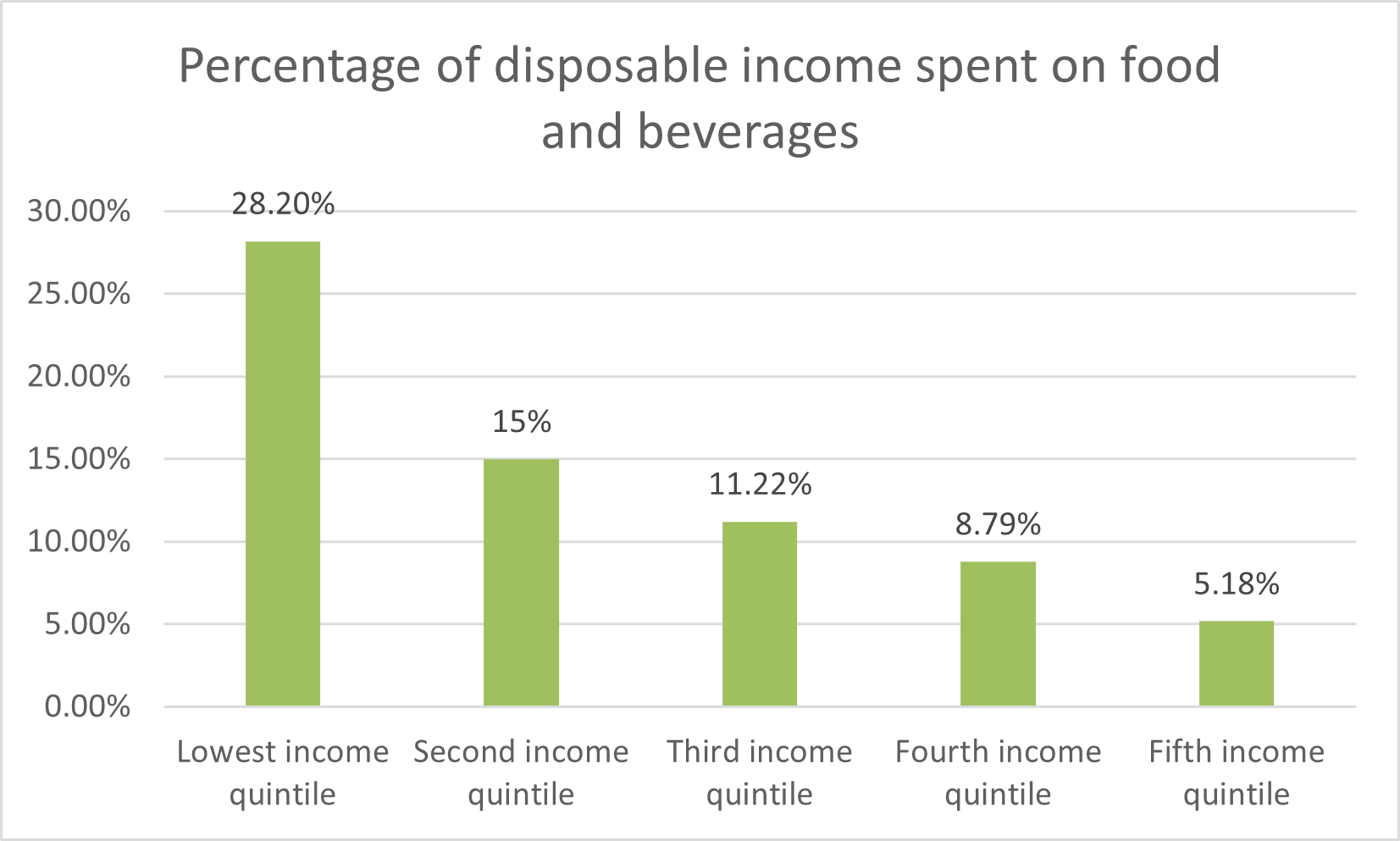
As can be seen in the graph above, the figures show a striking contrast: households in the lowest income quintile spent 28.20% of their disposable income on food and beverages last year, compared to 5.18% for households in the highest income quintile.
CFA would like to note that although consumers have watched grocery prices climb, it’s important to note that farmers receive only a small fraction of what shoppers pay at retail. Higher store prices do not necessarily translate into higher returns at the farm gate.
“The Food Freedom Day analysis shows us that despite Canada being a global food supplier, there are large segments of Canadians that are struggling with food affordability, and this burden seems to be growing,” said Keith Currie CFA President.
“With the threat of tariffs hanging over our head from the U.S. and other major trading partners, these food affordability concerns only highlight the critical importance of a united Canadian approach to maintaining open and predictable North American trade. This is essential to avoid exacerbating food affordability concerns and ensuring a resilient agriculture and food industry.”